INTROSPECTUS

Operational Insight

Operational Intelligence for Modern Australian Organisations

Operational Insight Module Overview

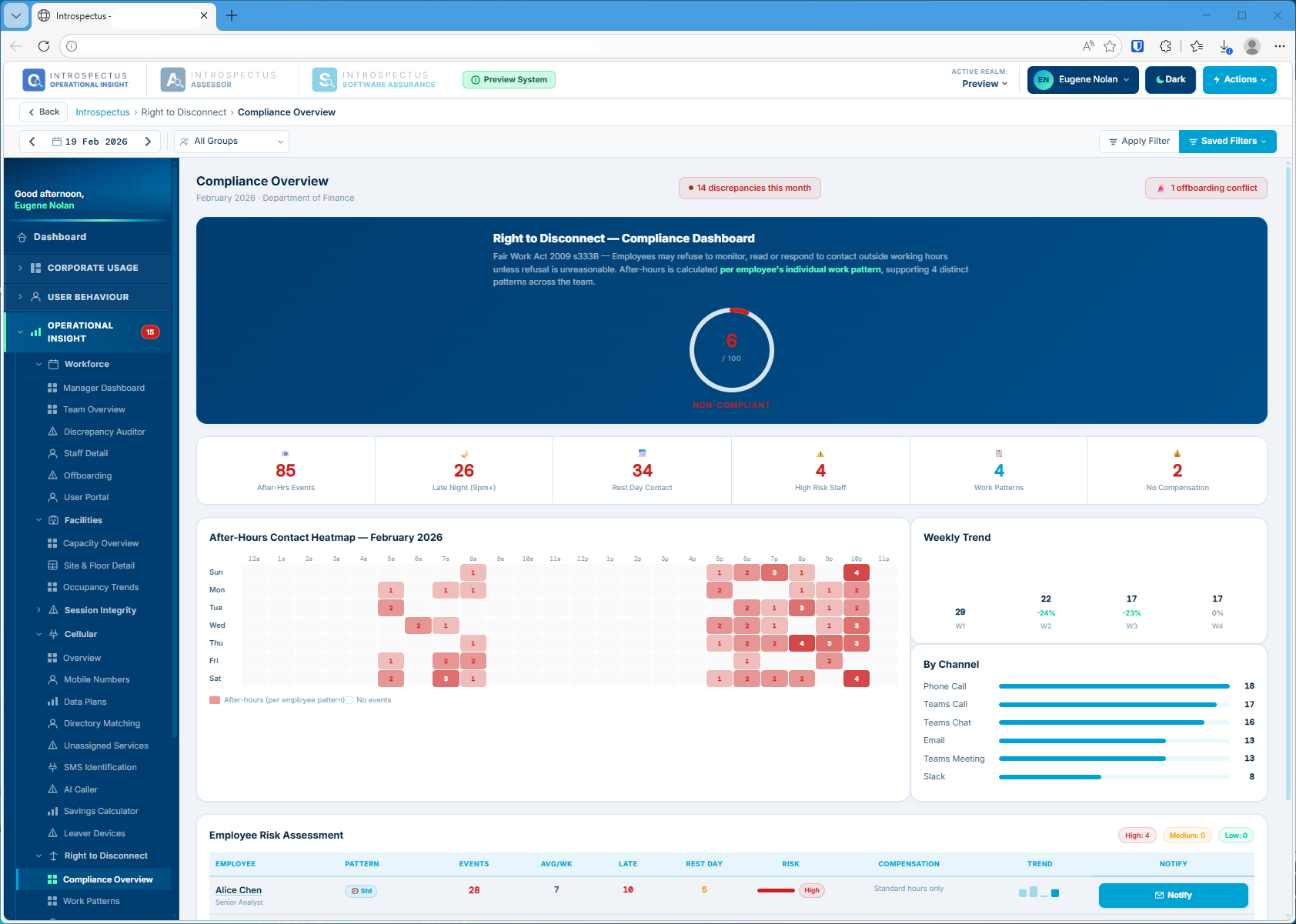
Know what’s happening across your workforce every day, in real time.

Managing attendance, hybrid work policies, leave compliance, and employee lifecycle events across multiple systems is complex and often fragmented.

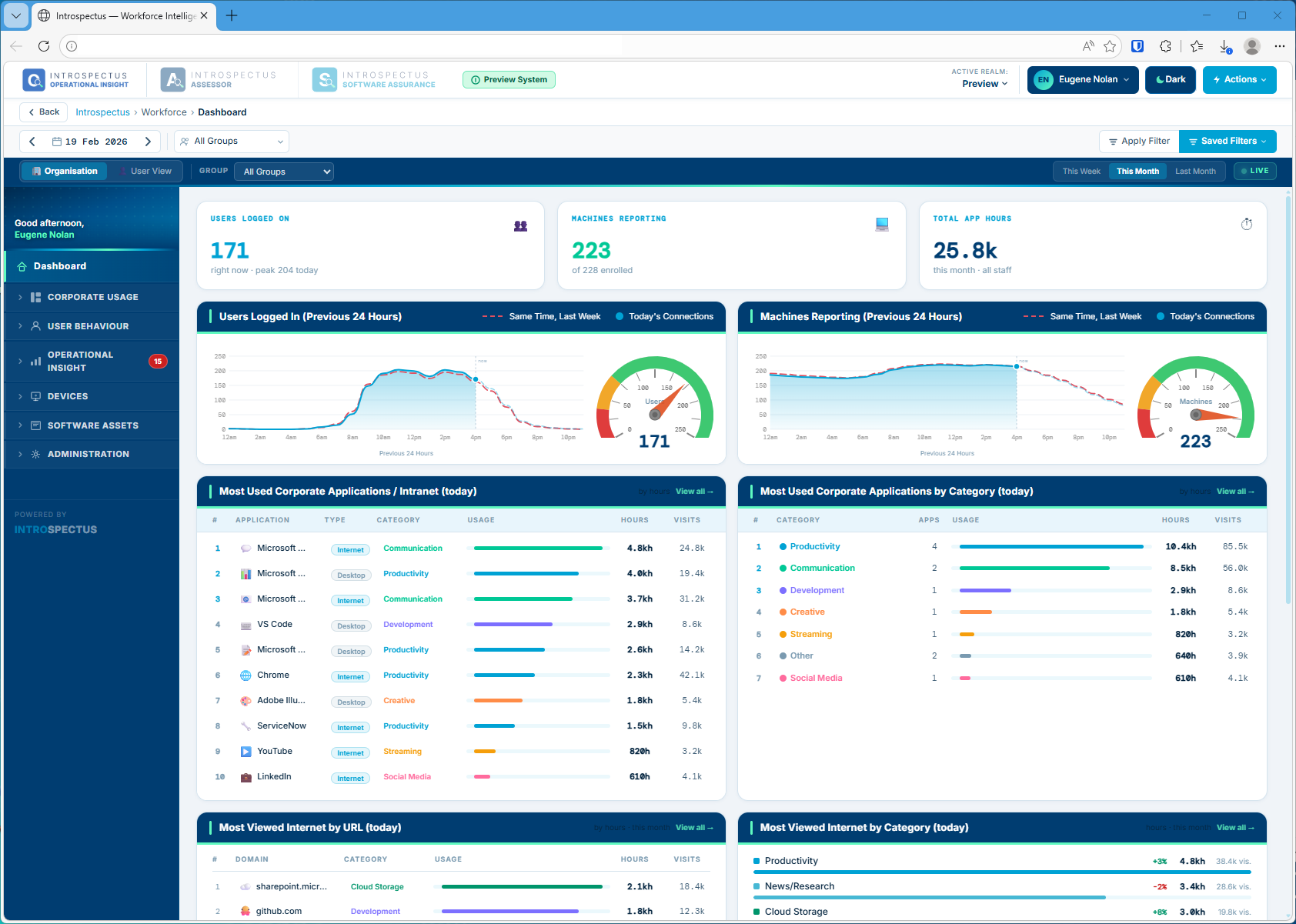
Introspectus Operational Insight unifies these signals into a single operational view, allowing executives and managers to understand how their workforce is actually operating not just what individual systems report.

By correlating data from your existing enterprise platforms including HR systems, Microsoft Entra ID, building access controls, VPN logs, and location signals, Introspectus surfaces insights that would otherwise remain hidden.

No new systems.
No duplicate data entry.
No disruption to existing workflows.

Instead, organisations gain accurate workforce visibility, automated discrepancy detection, and stronger operational control.

Manage Attendance

Manage attendance, hybrid work policies, leave compliance, and employee lifecycle.

Single Operational View

Allows executives and managers to understand how their workforce is operating.

Reveal Hidden Insights

Identifies discrepancies, compliance gaps, or security risks before they escalate.

Attendance Visibility & Discrepancy Detection

Introspectus Operational Insight continuously correlates signals from multiple enterprise systems to detect when workforce activity does not match recorded attendance or leave data.

A discrepancy is only flagged when multiple signals confirm the anomaly simultaneously for example:

This multi-signal verification model dramatically reduces false positives, ensuring that every flagged event reflects a genuine anomaly rather than incomplete or inconsistent data.

Managers receive clear, actionable insights not raw logs or fragmented system data.

Workforce Visibility

CapabilityWhat it DoesBusiness Impact
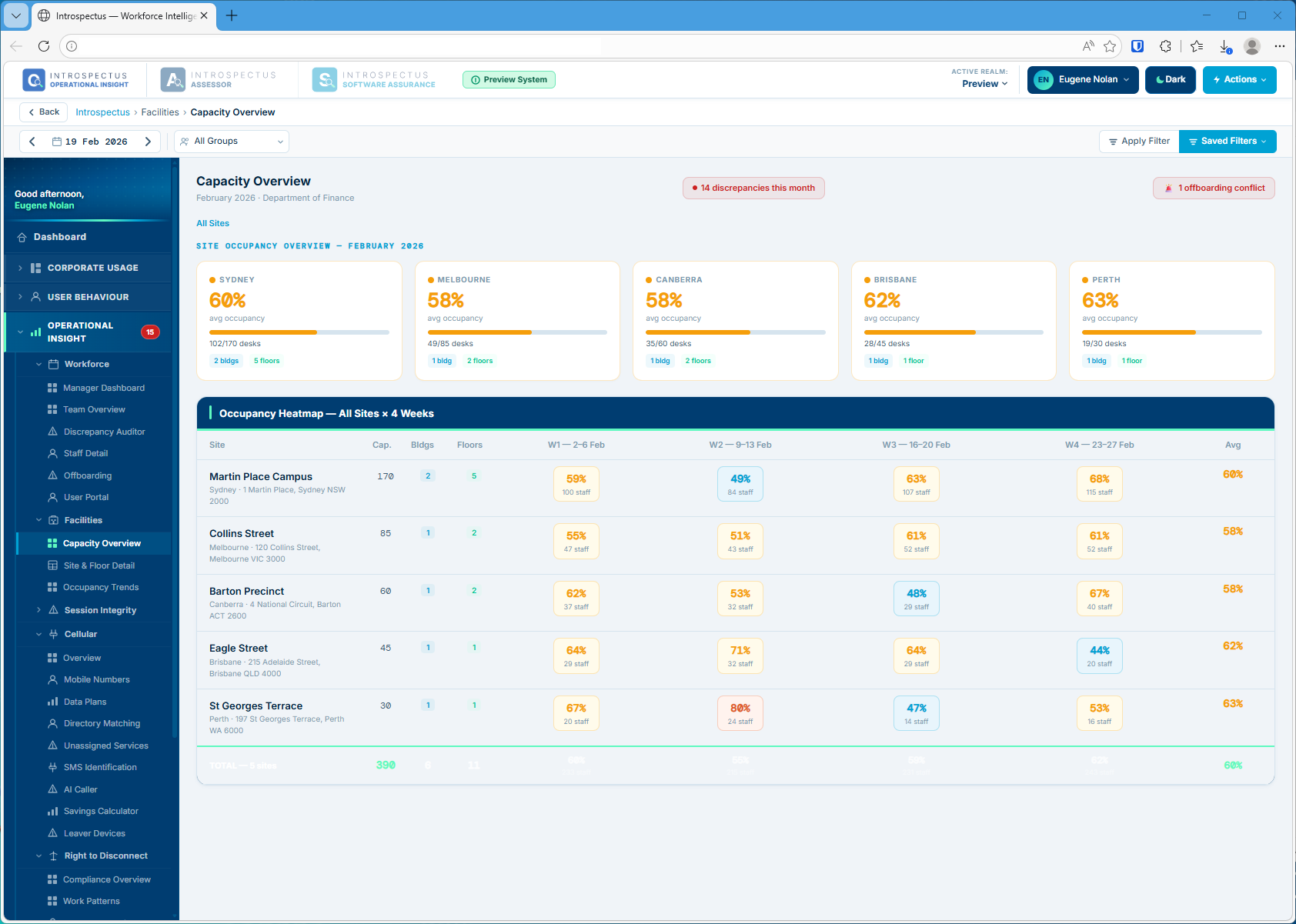
Manager DashboardProvides a real-time view of workforce status across the organisation. Instantly see who is in the office, working remotely, on leave, or unaccounted for.Managers start the day with immediate operational clarity and can respond quickly to attendance issues.
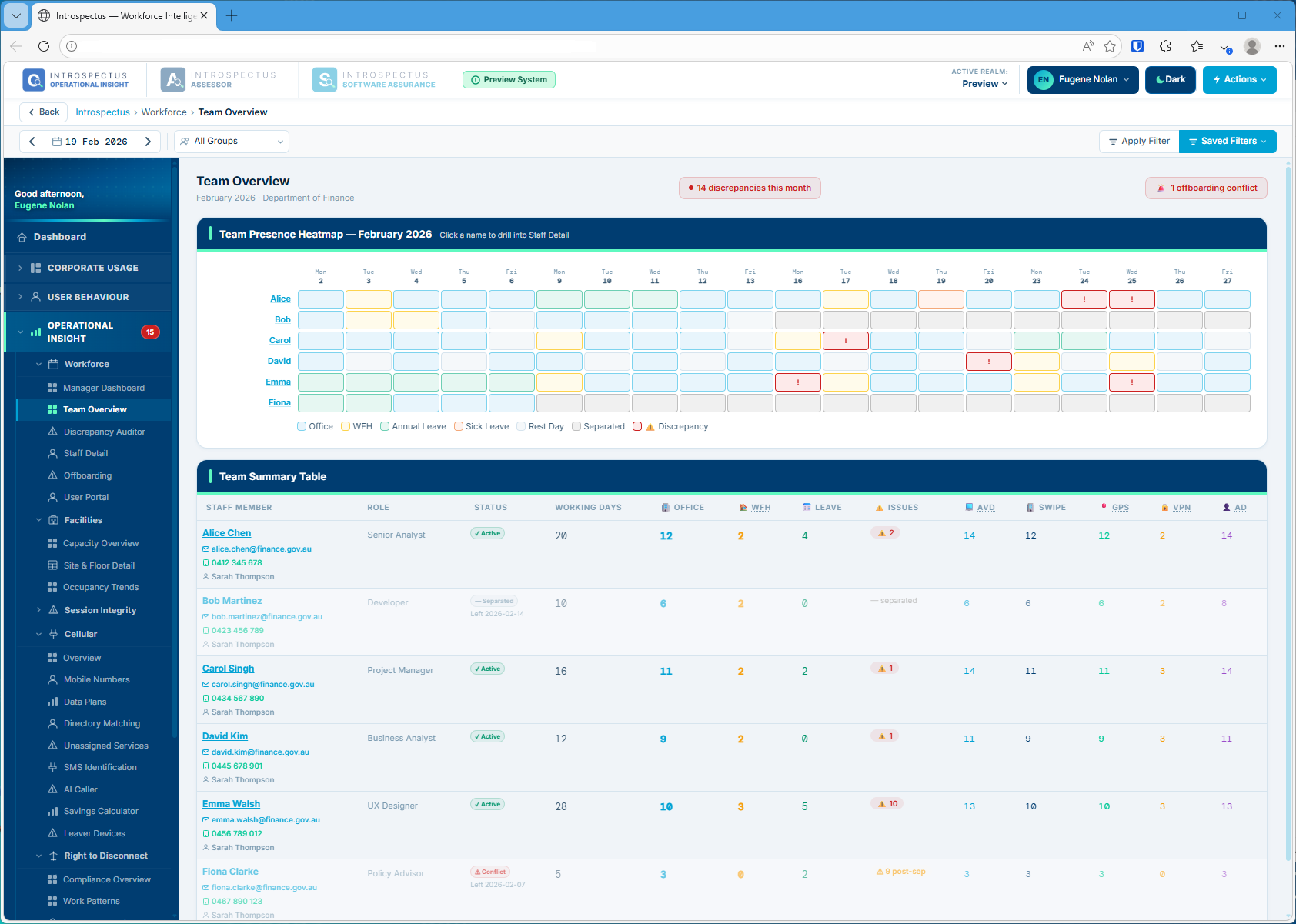
Team OverviewVisual calendar showing attendance patterns across the month, including office presence, remote work, leave, and discrepancies.Makes workforce patterns easy to identify and improves planning and oversight.
Staff Detail ViewDrill into individual attendance history, system signals, leave records, and flagged discrepancies.Supports HR conversations, investigations, and performance discussions with evidence.

Workforce Compliance & Audit

CapabilityWhat it DoesBusiness Impact
Discrepancy AuditorAutomatically identifies unexplained absences using correlated signals from multiple systems.Eliminates manual investigation and ensures anomalies are identified early.
WFH Policy ComplianceTracks remote work ratios against organisational policy and highlights exceptions..Helps enforce hybrid work policies consistently across the organisation.
Savings IndicatorCalculates estimated payroll recovery value from identified discrepancies.Provides executives with a measurable financial return from audit activities.

Employee Lifecycle & Security

CapabilityWhat it DoesBusiness Impact
Conflict DetectionIdentifies when connected systems disagree on employee status (e.g., active account after termination).Prevents security gaps that could expose the organisation to breaches or fraud.
SLA Offboarding ChecklistTracks every step in the offboarding process including account disablement, badge revocation, device wipe, and data transfer.Ensures every departure follows a consistent and auditable process.
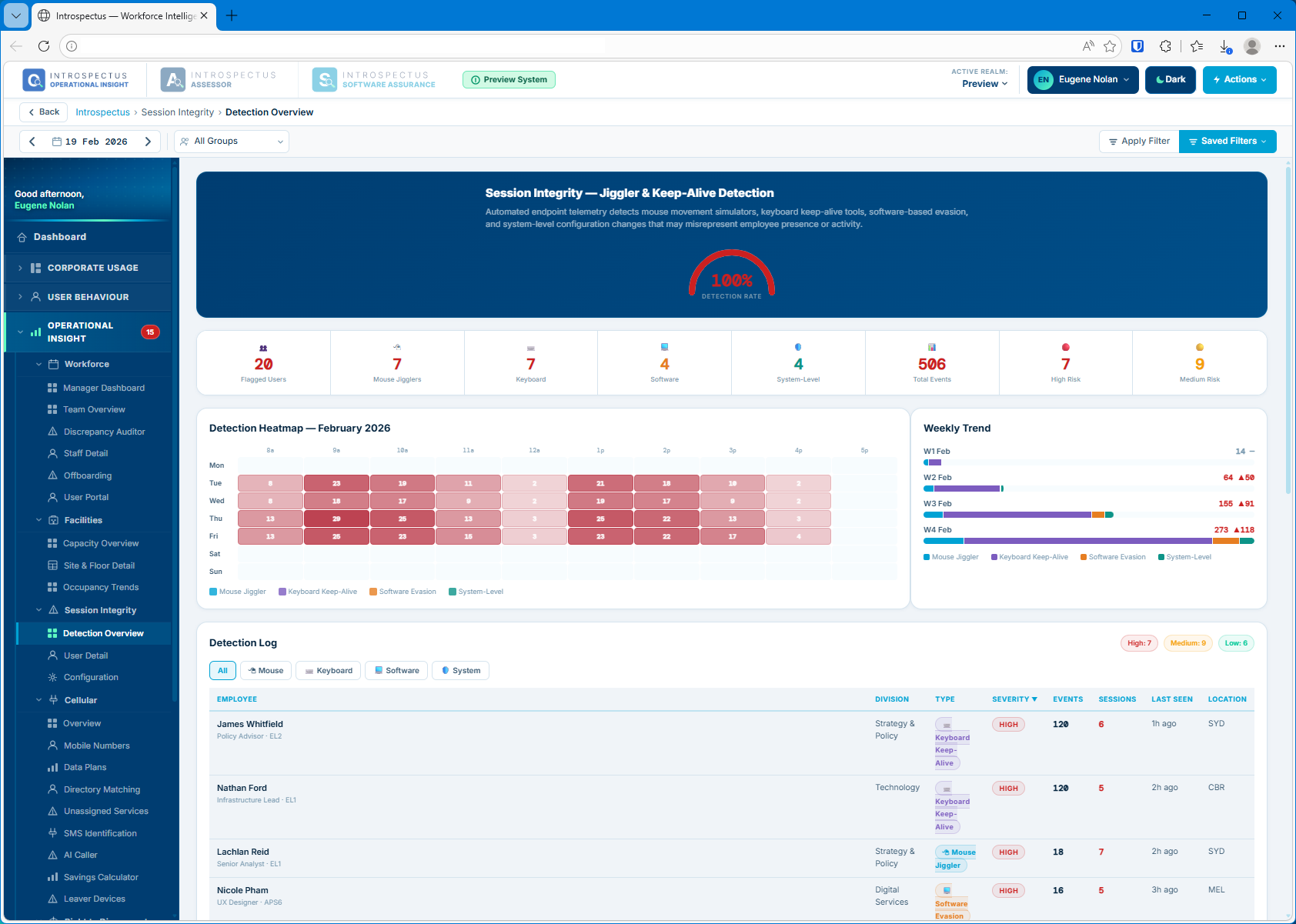
Post-Separation MonitoringDetects login attempts or system activity after employee departure.Provides an early warning for potential insider threats or security incidents.
Employee Self-Service PortalEmployees can review attendance records and system-detected activity.Improves transparency while reducing HR support requests.

What Introspectus Operational Insight Helps You Achieve

Clear workforce visibility strengthens decision‑making, reduces operational risk, and improves governance by turning existing systems into a reliable source of real‑time insight. It gives leaders the confidence to act quickly, consistently, and with evidence.

This allows organisations to achieve:

Executive Insight in Minutes, Not Reports

Introspectus Operational Insight gives decision-makers immediate visibility into workforce activity across the organisation.

By correlating data from multiple enterprise systems, the platform highlights discrepancies, policy breaches, and operational patterns that would otherwise remain hidden across disconnected platforms.

Executives gain clear operational intelligence without needing to interpret raw system logs or manual reports.

Why Introspectus Operational Insight?

Most workforce tools require organisations to already know what they are looking for. Introspectus identifies the gaps automatically.
By continuously analysing the difference between what systems record and what actually happens across the workforce, the platform surfaces insights that drive better management decisions.

Key Advantages:

What Makes Introspectus Different?

See how Introspectus Operational Insight compares to most workforce monitoring tools.

Most monitoring tools

Monitor activity
Track keystrokes
Invade privacy

Introspectus Operational Insight

Correlates enterprise signals
Detects operational anomalies
Protects employee privacy

How Introspectus Helps

Each agent compares the current patch list against what is actually installed on its device. Any gap between what has been released and what is deployed is immediately surfaced. Critically, Introspectus pays particular attention to the timing of patch deployment not just whether a patch is present, but when it was applied.

This temporal dimension is central to Essential Eight compliance, where the difference between a patch applied on day two versus day thirty can mean the difference between maturity levels, and between an environment that was protected and one that was exposed.

This combination of daily patch intelligence, severity-based filtering, agent-level validation, and deployment timing analysis gives organisations a real-time, evidence-based view of their operating system patch posture mapped directly to the ISM controls applicable to the Essential Eight patch operating systems strategy.

The Challenge with Patch Operating Systems

The visibility gap here is particularly consequential. A patch may be approved and scheduled, yet never successfully applied due to a failed deployment, a device that was offline during the maintenance window, a reboot that was deferred, or a system that exists outside managed channels entirely.

Organisations that rely solely on deployment tooling to confirm patch status are measuring intent, not reality. The ACSC is explicit on this point: organisations need to confirm patches have been applied successfully, not merely that they were dispatched.

Patch Operating Systems Overview

Within the Essential Eight framework, patching operating systems is a core and non-negotiable control. The ACSC sets clear expectations: patches for internet-facing infrastructure must be applied within 48 hours when identified as critical or where working exploits exist, and within two weeks for standard releases.

Patches for workstations, servers, and network devices must be applied within one month, with tighter timeframes applying in high-threat environments. Critically, the ACSC also mandates that vulnerability scanning occurs at least daily for internet-facing systems and at least fortnightly for workstations and non-internet-facing infrastructure not to replace patching, but to confirm it has actually occurred.

How Introspectus Works

From this inventory, Introspectus performs targeted web intelligence gathering. For each application identified, the platform locates the top five authoritative sources of patch and release information vendor security advisories, release notes, and vulnerability databases and retrieves that content into a central repository.

Aletheia, Introspectus’s AI analysis agent, then reads and analyses this content to extract the intelligence that matters for application patching: the latest available version, whether a release addresses a security vulnerability, the severity of that vulnerability, and all information relevant to the Essential Eight application patching requirements. This structured intelligence is mapped directly to the applicable ISM controls, producing defensible, audit-ready evidence of an organisation’s application patch compliance posture.

The Challenge with Patch Applications

A critical and frequently overlooked problem is the visibility gap. Organisations may believe their applications are current when, in reality, patches have silently failed, devices have missed deployment windows, or software has been installed outside of managed channels entirely.

Without continuous inspection at the endpoint level, these gaps go undetected until an audit or, worse, a breach.

Patch Applications Overview

Within the Essential Eight standard, patching applications is a dedicated and non-negotiable control. The ACSC specifies clear timeframes: critical vulnerabilities in internet-facing services must be addressed within 48 hours, commonly used applications such as office productivity suites, web browsers, email clients and PDF software must be patched within two weeks of release, and all other applications within one month.

For organisations in high-threat environments, the bar is higher still. Meeting these requirements consistently across hundreds of distinct applications deployed across thousands of endpoints is not achievable through manual effort alone.