Patch Operating Systems

Maintaining control over foundational risk.

A single unpatched operating system can provide an attacker with the foothold needed to cause significant harm.

Overview

The operating system is the foundation upon which everything else runs. When it is unpatched, every application, service, and user operating on top of it is exposed.

Operating system vulnerabilities are among the most actively targeted by malicious actors they are well-documented, widely publicised, and in many cases weaponised within hours of public disclosure. A single unpatched vulnerability in a workstation or server operating system can provide an attacker with the foothold needed to move laterally, escalate privileges, and cause significant harm.

Within the Essential Eight framework, patching operating systems is a core and non-negotiable control. The ACSC sets clear expectations: patches for internet-facing infrastructure must be applied within 48 hours when identified as critical or where working exploits exist, and within two weeks for standard releases.

Patches for workstations, servers, and network devices must be applied within one month, with tighter timeframes applying in high-threat environments. Critically, the ACSC also mandates that vulnerability scanning occurs at least daily for internet-facing systems and at least fortnightly for workstations and non-internet-facing infrastructure not to replace patching, but to confirm it has actually occurred.

The Challenge

Microsoft releases operating system patches on a regular and frequent cadence.

Each release may contain dozens of individual fixes spanning security vulnerabilities, critical updates, and cumulative rollups each with its own severity rating and risk profile.

Keeping pace with this volume, filtering what is genuinely critical from what is routine, and then confirming that every device across the estate has actually received and applied the right patches is an enormous operational undertaking.

The visibility gap here is particularly consequential. A patch may be approved and scheduled, yet never successfully applied due to a failed deployment, a device that was offline during the maintenance window, a reboot that was deferred, or a system that exists outside managed channels entirely.

Organisations that rely solely on deployment tooling to confirm patch status are measuring intent, not reality. The ACSC is explicit on this point: organisations need to confirm patches have been applied successfully, not merely that they were dispatched.

Some pertinent figures:

of companies who had a data breach or a failed audit could have prevented it by patching on time or doing configuration updates - Voke Media survey, 2016.
0 %
of organizations admitted that they don't even scan for vulnerabilities - Ponemon Report, 2018.
0 %
of all vulnerabilities caused by unpatched software are classified as High Risk or Critical - Edgescan Stats Report, 2018.
0 %

How Introspectus Helps

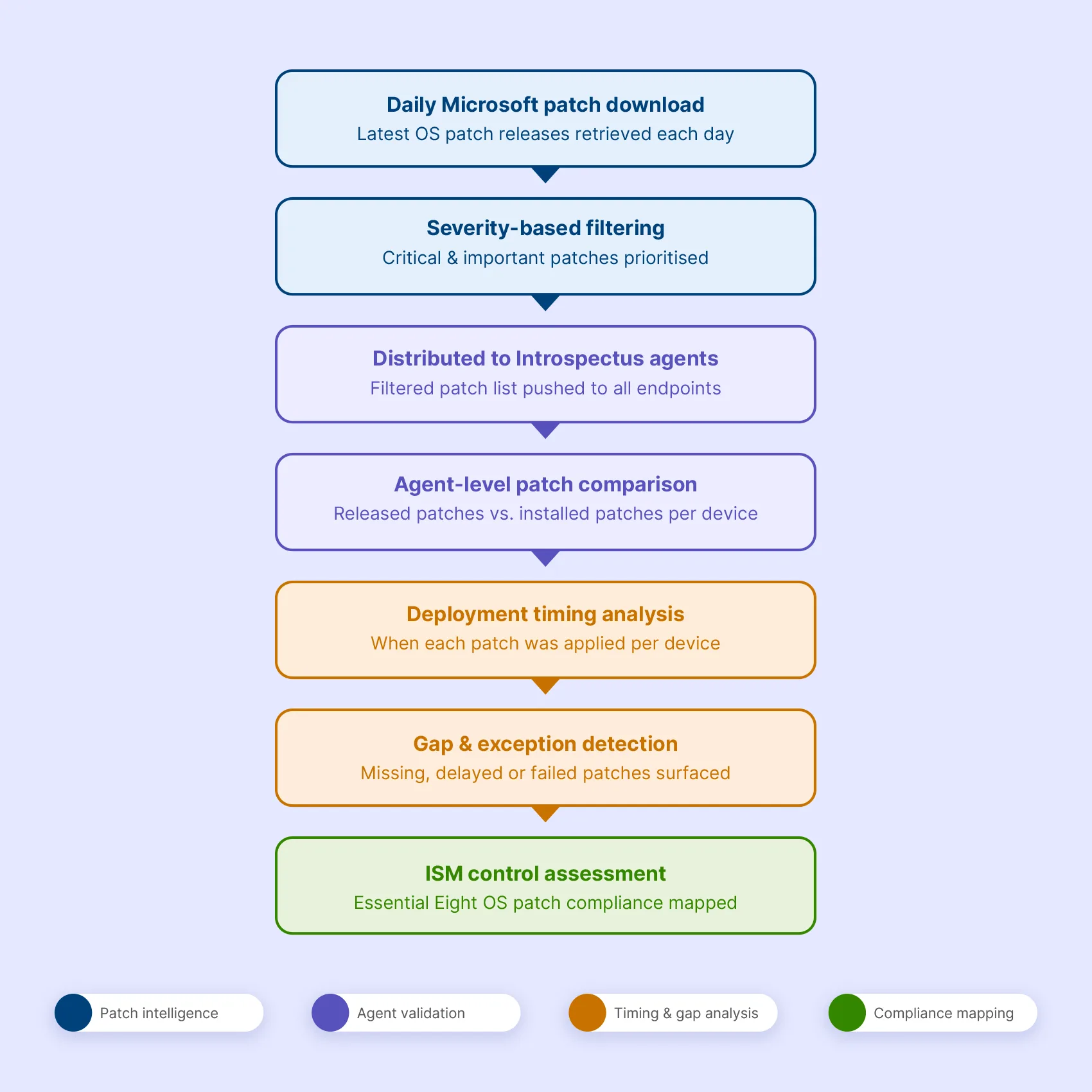
Introspectus Assessor takes a direct, continuously updated approach to operating system patch intelligence one built around what Microsoft actually releases, filtered for what matters most, and validated against what is genuinely deployed on every device.

Each day, Introspectus downloads the latest Microsoft patch release list. This list is immediately filtered by severity, prioritising critical and important updates that carry the greatest risk if left unapplied particularly those associated with known exploits or actively targeted vulnerabilities.

This filtered intelligence is then distributed to all Introspectus agents deployed across the client environment.

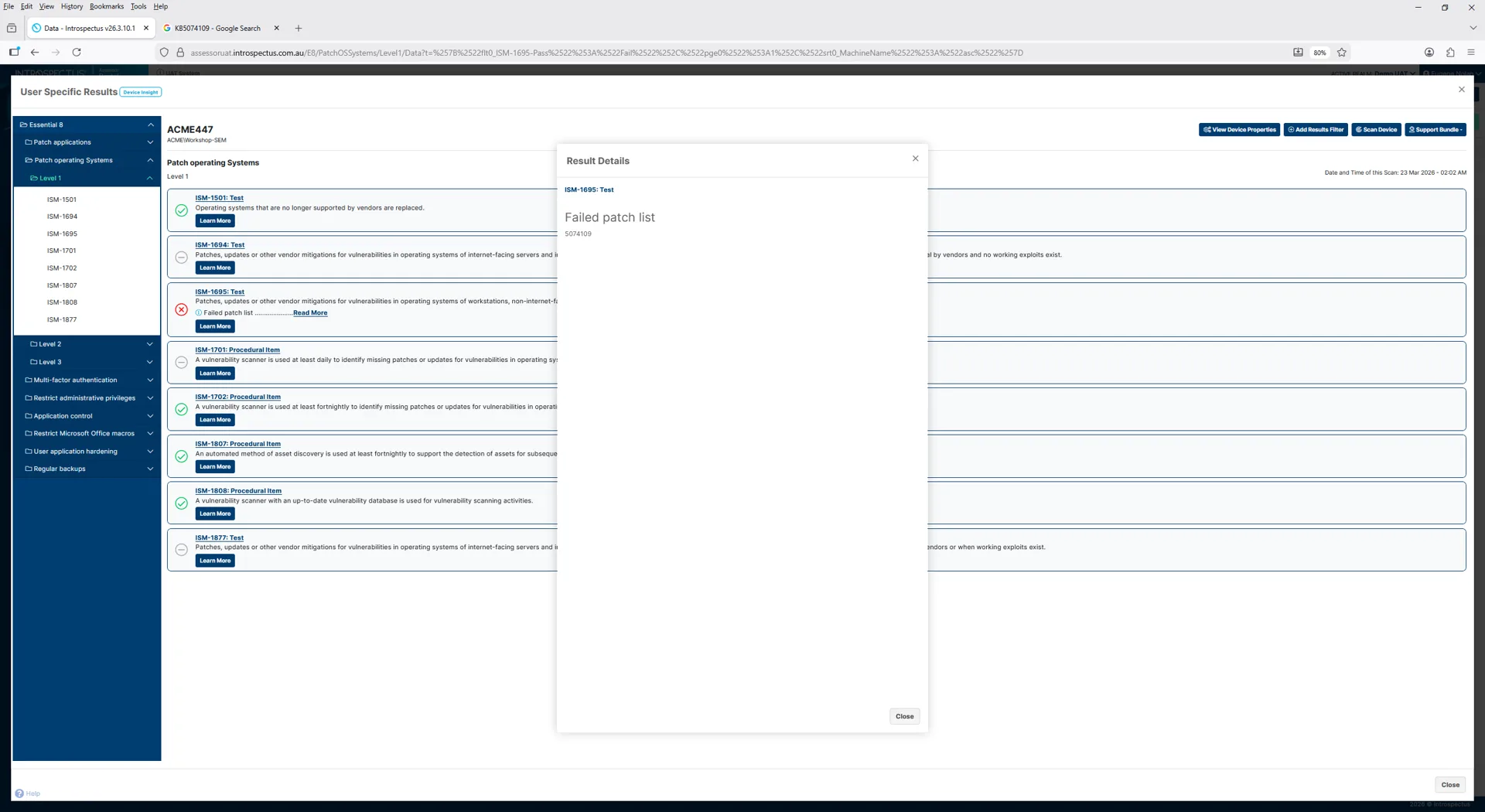
Each agent compares the current patch list against what is actually installed on its device. Any gap between what has been released and what is deployed is immediately surfaced. Critically, Introspectus pays particular attention to the timing of patch deployment not just whether a patch is present, but when it was applied.

This temporal dimension is central to Essential Eight compliance, where the difference between a patch applied on day two versus day thirty can mean the difference between maturity levels, and between an environment that was protected and one that was exposed.

This combination of daily patch intelligence, severity-based filtering, agent-level validation, and deployment timing analysis gives organisations a real-time, evidence-based view of their operating system patch posture mapped directly to the ISM controls applicable to the Essential Eight patch operating systems strategy.

How Introspectus works:

Built for Governance and Assurance

Operating system patching is one of the clearest indicators of an organisation’s overall security discipline.

It is measurable, time-bound, and directly tied to known risk. Boards and executives are increasingly expected to demonstrate not just that patching policies exist, but that they are being executed consistently and that compliance can be evidenced.

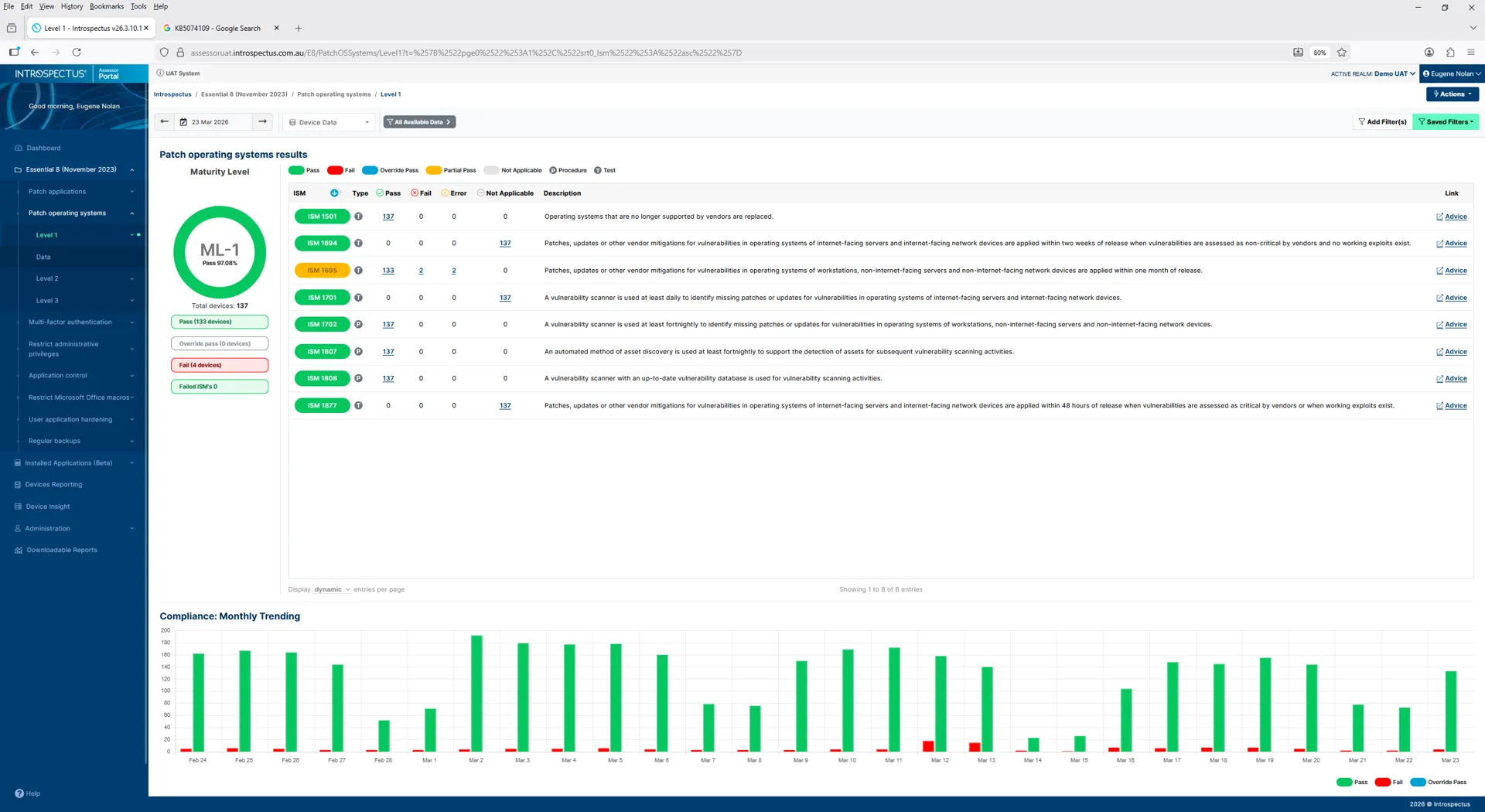
Introspectus delivers that evidence continuously. Patch deployment timing is tracked, gaps are identified in real time, and compliance posture is maintained as a living record rather than a snapshot prepared for audit. Organisations move from hoping their systems are patched to knowing they are and being able to prove it.

Click image to enlarge

The Outcome

The key distinction from the application patching process is the emphasis on timing the OS patching diagram reflects that Introspectus doesn’t just check whether a patch is present, but precisely when it arrived, which is what determines Essential Eight maturity level compliance.

Know your security. Prove your compliance. Improve continuously.

How Introspectus Helps

Each agent compares the current patch list against what is actually installed on its device. Any gap between what has been released and what is deployed is immediately surfaced. Critically, Introspectus pays particular attention to the timing of patch deployment not just whether a patch is present, but when it was applied.

This temporal dimension is central to Essential Eight compliance, where the difference between a patch applied on day two versus day thirty can mean the difference between maturity levels, and between an environment that was protected and one that was exposed.

This combination of daily patch intelligence, severity-based filtering, agent-level validation, and deployment timing analysis gives organisations a real-time, evidence-based view of their operating system patch posture mapped directly to the ISM controls applicable to the Essential Eight patch operating systems strategy.

The Challenge with Patch Operating Systems

The visibility gap here is particularly consequential. A patch may be approved and scheduled, yet never successfully applied due to a failed deployment, a device that was offline during the maintenance window, a reboot that was deferred, or a system that exists outside managed channels entirely.

Organisations that rely solely on deployment tooling to confirm patch status are measuring intent, not reality. The ACSC is explicit on this point: organisations need to confirm patches have been applied successfully, not merely that they were dispatched.

Patch Operating Systems Overview

Within the Essential Eight framework, patching operating systems is a core and non-negotiable control. The ACSC sets clear expectations: patches for internet-facing infrastructure must be applied within 48 hours when identified as critical or where working exploits exist, and within two weeks for standard releases.

Patches for workstations, servers, and network devices must be applied within one month, with tighter timeframes applying in high-threat environments. Critically, the ACSC also mandates that vulnerability scanning occurs at least daily for internet-facing systems and at least fortnightly for workstations and non-internet-facing infrastructure not to replace patching, but to confirm it has actually occurred.

How Introspectus Works

From this inventory, Introspectus performs targeted web intelligence gathering. For each application identified, the platform locates the top five authoritative sources of patch and release information vendor security advisories, release notes, and vulnerability databases and retrieves that content into a central repository.

Aletheia, Introspectus’s AI analysis agent, then reads and analyses this content to extract the intelligence that matters for application patching: the latest available version, whether a release addresses a security vulnerability, the severity of that vulnerability, and all information relevant to the Essential Eight application patching requirements. This structured intelligence is mapped directly to the applicable ISM controls, producing defensible, audit-ready evidence of an organisation’s application patch compliance posture.

The Challenge with Patch Applications

A critical and frequently overlooked problem is the visibility gap. Organisations may believe their applications are current when, in reality, patches have silently failed, devices have missed deployment windows, or software has been installed outside of managed channels entirely.

Without continuous inspection at the endpoint level, these gaps go undetected until an audit or, worse, a breach.

Patch Applications Overview

Within the Essential Eight standard, patching applications is a dedicated and non-negotiable control. The ACSC specifies clear timeframes: critical vulnerabilities in internet-facing services must be addressed within 48 hours, commonly used applications such as office productivity suites, web browsers, email clients and PDF software must be patched within two weeks of release, and all other applications within one month.

For organisations in high-threat environments, the bar is higher still. Meeting these requirements consistently across hundreds of distinct applications deployed across thousands of endpoints is not achievable through manual effort alone.